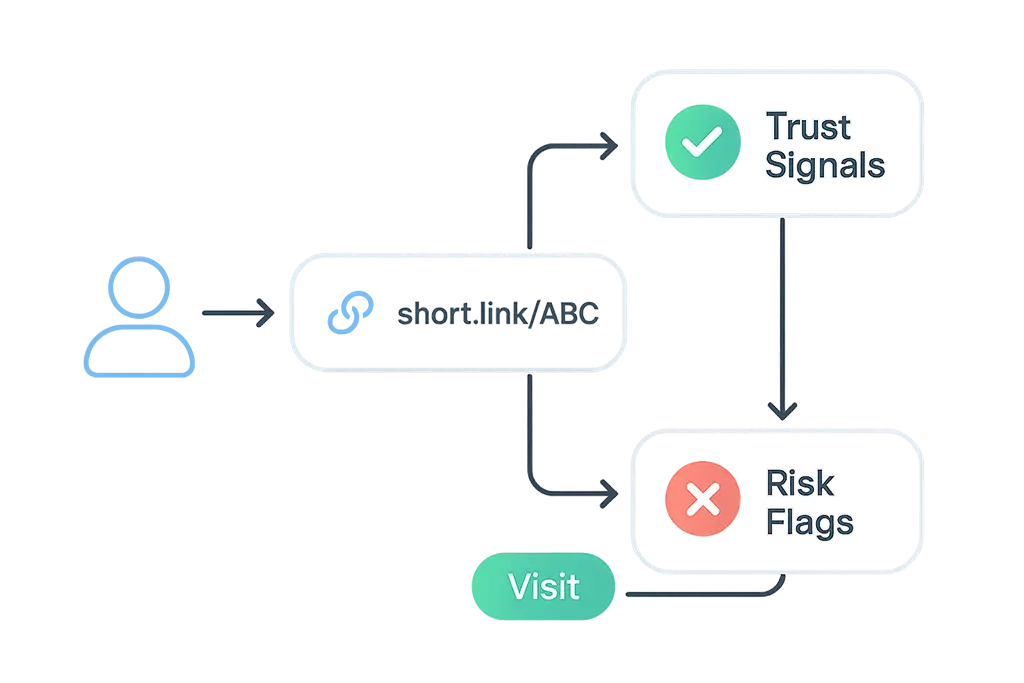
Short URLs are everywhere — emails, ad campaigns, QR codes, SMS messages, even printed receipts. And yet, despite years of widespread use, a significant portion of users still pause before clicking one. That moment of hesitation is not random. It's the result of pattern recognition built from years of exposure to phishing attempts, spam, and outright scams. For anyone running a short URL service or using one in a marketing context, understanding that hesitation is not optional — it's foundational.
I've been running vvd.im as a URL shortening and link tracking service, and measuring click behavior across campaigns has made one thing clear: the link itself is part of the user experience. A poorly designed short link — even one pointing to a perfectly legitimate destination — can tank click-through rates before the landing page ever gets a chance to do its job.
In this article, I'm going to break down why users hesitate to click short URLs, what's actually happening psychologically and technically at that moment, and what concrete steps you can take — as a developer or marketer — to design links that earn trust instead of eroding it.
The Psychology of Clicking: How Users Evaluate Links
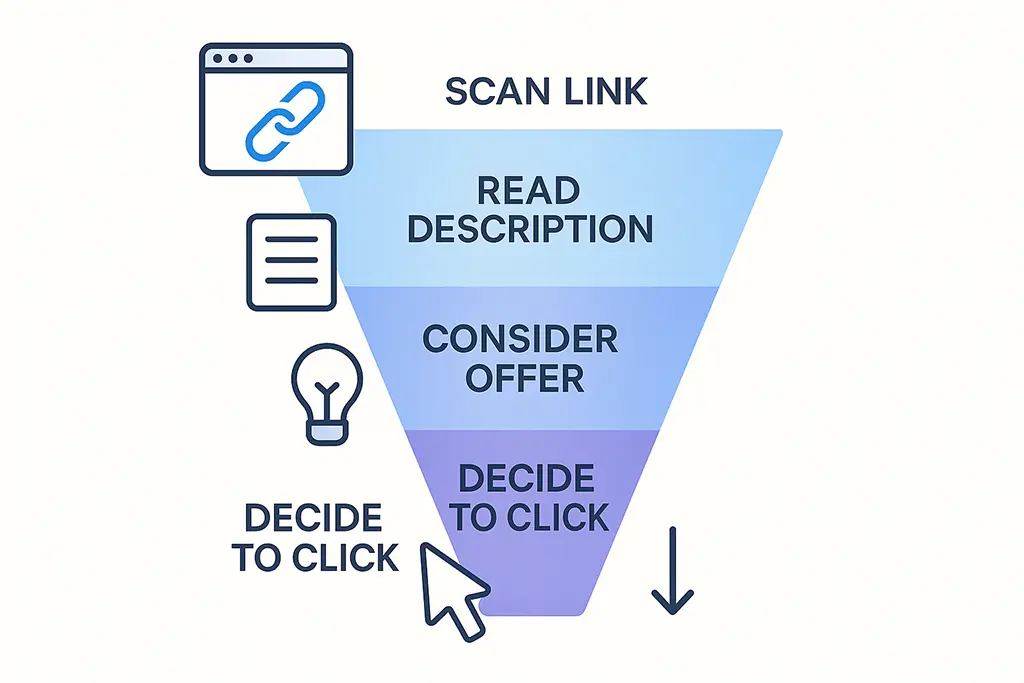
When a user encounters a link, the decision to click is not a deliberate, analytical process. It happens in under 200 milliseconds — closer to pattern matching than reasoning. The brain is essentially running a threat assessment using partial information: domain name, surrounding context, sender identity, and visual cues.
Short URLs strip away most of that signal. A URL like vvd.im/abc123 offers essentially nothing — no domain hint, no path context, no parameter structure that a savvy user can inspect. What's left is a compact string that demands trust without supplying evidence. That's a hard sell, especially for users who have been burned before.
The behavioral model here is well-studied. According to heuristic evaluation research, users apply fast, low-effort rules when processing information under uncertainty. For links, the heuristic often boils down to: Does this look like something I've seen before that turned out to be safe? Short URLs on unfamiliar domains consistently fail that check.
This is also why context matters so much. The same short URL performs differently in an email from a known sender versus in a comment section on a random forum. The URL hasn't changed — the surrounding signal has.
The Cost of Uncertainty on Engagement
From a UX perspective, uncertainty is friction. And friction, even minor friction, compounds on mobile. A user scrolling a feed on a phone with background notifications and a short attention window will default to skipping anything that requires a mental effort to evaluate. The link doesn't need to look malicious to be ignored — it just needs to feel uncertain.
I've seen this in practice when A/B testing link formats in email campaigns. Switching from opaque slugs (vvd.im/x9k2p) to readable slugs (vvd.im/spring-sale) improved click-through by measurable margins on mobile, with almost no difference on desktop. Mobile users were more sensitive to ambiguity — which aligns with what we know about fragmented attention and cognitive load on smaller screens.
The silent failure mode here is dangerous: the analytics look clean (no errors, low bounce), but clicks simply don't happen. Users don't report the problem. They just scroll past.
Short URLs and the Legacy of Abuse
The trust deficit around short URLs didn't appear out of nowhere. It was built over years of misuse. Services like bit.ly and TinyURL — both legitimate — became the infrastructure of choice for spam campaigns and phishing attacks in the 2010s precisely because they were free, anonymous, and produced URLs that looked identical whether they pointed to a news article or a credential harvesting page.
That association is sticky. Security awareness training in corporate environments still routinely includes warnings like "do not click shortened URLs in emails." The intent is reasonable, but the effect is that even clean, well-intentioned short links carry residual suspicion that their creators didn't earn.
The deeper problem is visual indistinguishability. A URL like bit.ly/3xKpQ2m provides no surface-level signal about intent. And because users have learned (correctly, in some cases) that this opacity correlates with risk, they treat all opaque short links as suspect — regardless of origin.
Trust Is Earned Through Repetition, Not Declaration
One thing that becomes apparent when you operate a link service over time is that trust isn't something you announce — it's something users accumulate through consistent positive outcomes. If users click links from your domain repeatedly and nothing bad happens, the domain starts to feel safe. That's essentially Pavlovian conditioning applied to URLs.
The inverse is also true and significantly more punishing. A single bad outcome — a redirect to an unexpected page, a browser warning, a slow load — can reset that accumulated trust or push it negative. This asymmetry means that maintaining link quality is not just a technical SLA. It's a trust management problem.
For vvd.im, this shaped decisions around abuse prevention early on. Every link that gets created on the platform goes through validation before it can be clicked. Not just format checking — actual destination reputation checks. Because one malicious link that makes it into a user's browser can undo months of trust-building with that user, and potentially with anyone they tell about it.
Why Branded Domains Change Everything
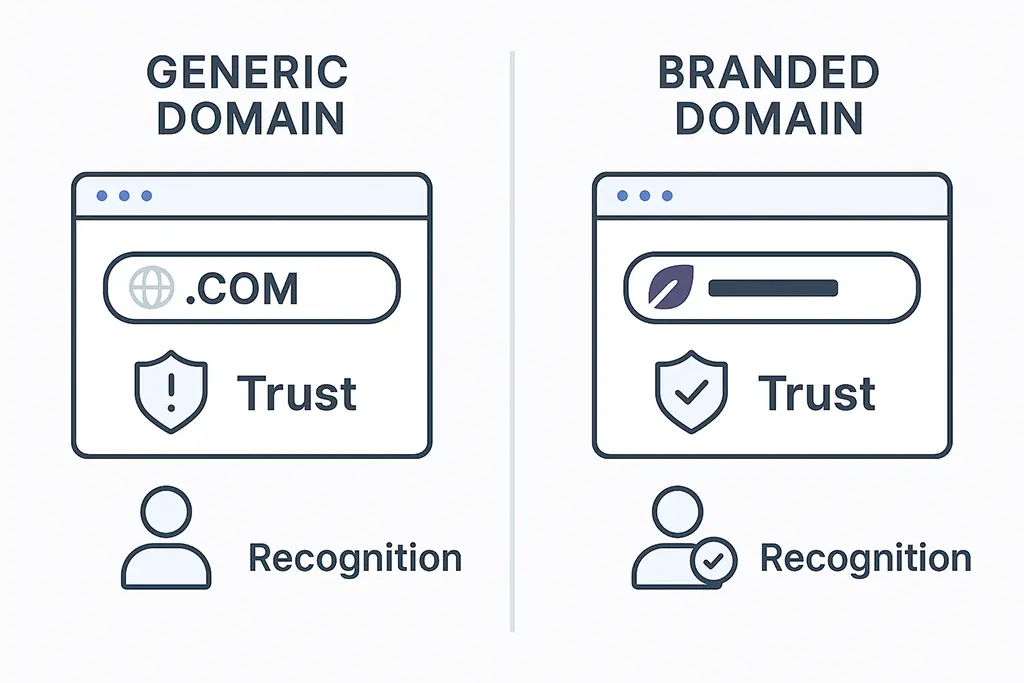
The single most effective lever for improving click trust on short links is the domain itself. A branded short domain — one that visibly belongs to a recognizable entity — answers the first and most important question users have: "Who is behind this?"
When a user sees nike.onelink.me/xyz versus bit.ly/3xKpQ2m, the first link is anchored to an identity they can evaluate. They may not recognize the specific URL path, but the domain gives them enough context to lower their guard. The second link offers nothing.
This is why, for enterprise campaigns and high-stakes conversion flows, custom short domains are essentially non-negotiable. The performance difference is real. It's not just aesthetics — it's signal density.
On vvd.im, branded domains are supported through custom domain routing. A company can configure their own subdomain (e.g., go.example.com) to use the vvd.im redirect infrastructure while keeping their brand identity in the URL. The technical setup involves pointing a CNAME to the vvd.im edge servers, and the Spring Boot application handles routing based on the incoming Host header. Here's a simplified version of how that routing logic works in practice:
@GetMapping("/{slug}")
public ResponseEntity<Void> redirect(
        @PathVariable String slug,
        HttpServletRequest request) {

    String host = request.getServerName(); // e.g., go.example.com
    Optional<ShortLink> link = linkService.resolve(slug, host);

    return link.map(l -> ResponseEntity
                .status(HttpStatus.MOVED_PERMANENTLY)
                .header(HttpHeaders.LOCATION, l.getTargetUrl())
                .build())
            .orElse(ResponseEntity.notFound().build());
}
The host parameter is used to scope link resolution, so the same slug can safely exist across multiple custom domains without collision. This also means redirect analytics are automatically segmented by brand — useful for attributing performance to specific campaigns or partners.
Predictable Disclosure vs. Full Transparency
There's a counterintuitive nuance here: users don't actually need to know everything about a link to trust it. They need to know enough, consistently. Predictability is more valuable than transparency at the extremes.
Exposing raw tracking URLs — the kind with utm_source, utm_medium, fbclid, gclid, and half a dozen other parameters — can actually erode trust for sophisticated users who recognize that they're being tracked extensively. A clean short URL with a readable slug, on a recognizable domain, is often the right balance: it hides the implementation details while revealing enough identity to feel safe.
Where this breaks down is when branded domains are used inconsistently. If a brand uses their custom short domain for some campaigns but falls back to a generic service for others, users lose the pattern. Consistency is load-bearing.
Redirects, Latency, and the Post-Click Trust Window
Most discussions about link trust focus on the pre-click moment. But there's a post-click trust window that's equally important — the 300 to 800 milliseconds between when a user clicks and when the destination page starts loading. What happens in that window determines whether the click converts to engagement or results in an immediate back-button press.
Redirect chains are the primary offender here. A link that goes through three or four redirects before reaching the destination introduces perceivable delay, and more importantly, multiple opportunities for something to go wrong. Each hop is another DNS lookup, another TCP connection, another server that has to respond within SLA. On a mobile network with 150ms base latency, a three-hop redirect chain can cost 500ms before the first byte of content is delivered.
On the infrastructure side, reducing redirect latency requires decisions at multiple layers. For vvd.im running on Nginx 1.28 + Spring Boot on Ubuntu 24.04, the redirect logic is handled at the application layer, but Nginx is configured to pass the original X-Forwarded-For and Host headers cleanly so that geolocation-based routing decisions can be made without adding a second hop:
# Nginx location block for redirect service
location / {
    proxy_pass http://springboot_upstream;
    proxy_set_header Host $host;
    proxy_set_header X-Forwarded-For $proxy_add_x_forwarded_for;
    proxy_set_header X-Real-IP $remote_addr;

    # Avoid redirect buffering delay
    proxy_buffering off;
    proxy_read_timeout 3s;
}
Redis is used for slug-to-URL resolution caching. A cache hit on a slug lookup completes in under 1ms in practice, which means the total redirect response time from Nginx receipt to 301 delivery is typically under 5ms in the warm-cache case. Cold cache hits fall back to MariaDB, adding roughly 10-20ms depending on query complexity and index health.
The practical implication: if you're running your own redirect infrastructure and seeing p99 latencies above 100ms, that's worth investigating not just as a performance problem, but as a trust problem.
Browser Warnings Are Trust Killers
Nothing ends a redirect chain's relationship with a user faster than a browser interstitial. Safe Browsing warnings, certificate errors, mixed content warnings — each of these is a trust-destroying event that users remember and associate with the link source, not just the destination.
This means SSL configuration on your redirect service needs to be treated with the same rigor as your main application. Wildcard certificates for custom domains, HSTS preloading, and proper OCSP stapling are not optional for a redirect service that wants users to trust it at scale. An expired cert on a custom short domain is a support ticket and a trust problem rolled into one.
Designing Short Links That Build Trust
Practical Trust Checklist
- Use a branded short domain consistently — never mix with generic services in the same campaign
- Keep redirects to one hop; eliminate intermediate tracking redirects where possible
- Use descriptive slugs (
/spring-sale) instead of opaque hash strings (/x9k2p) - Ensure p99 redirect latency stays under 50ms — anything above 100ms is perceptible
- Match the implied promise in the slug to the actual landing page content
- Monitor SSL certificate expiry on all custom domains actively, not reactively
Slug design deserves more attention than it typically gets. The slug is the one piece of user-facing information in a short URL that you have full control over. A slug like /q4-webinar-registration tells the user something meaningful. A slug like /8f3kLm tells them nothing, and in the absence of information, suspicion fills the gap.
For programmatically generated slugs where human-readable names aren't practical, a middle path is using short but non-random strings — combinations of real words rather than random characters. /bold-river is opaque about destination but still feels more human than /8f3kLm. That distinction matters at the subconscious level.
One pattern I've found effective for high-stakes campaign links: preview URLs. Rather than sending users directly to the destination, the short URL resolves to a lightweight preview page that shows the destination domain and a brief description, with a clear "Continue" button. This adds one interaction but eliminates uncertainty almost entirely. Conversion rates on this pattern depend heavily on the audience — for cold traffic, the reduction in suspicion outweighs the friction. For warm audiences who already trust the brand, it's usually unnecessary.
Trust Is Infrastructure, Not a Feature
The throughline in all of this is that link trust isn't a design decision you make once. It's a property of your entire system — your domain choices, your redirect latency, your abuse prevention, your SSL hygiene, your slug conventions — all of it contributes to whether a user's nervous system says "safe" or "skip" in that 200-millisecond window before they decide.
For developers building or operating short URL infrastructure, the implication is that performance and security work isn't separate from user experience work. A 300ms redirect is a UX problem. An inconsistent domain strategy is a conversion problem. A lax abuse policy is a trust problem that affects every legitimate link on your platform.
Users hesitate to click short URLs because the cost of a wrong click — wasted time, potential security risk, violated expectations — feels real to them, even if it's statistically small. When your system consistently proves that cost won't be incurred, hesitation dissolves. That's the actual goal. Not a clever slug, not a beautiful landing page — a track record that makes clicking feel obvious.