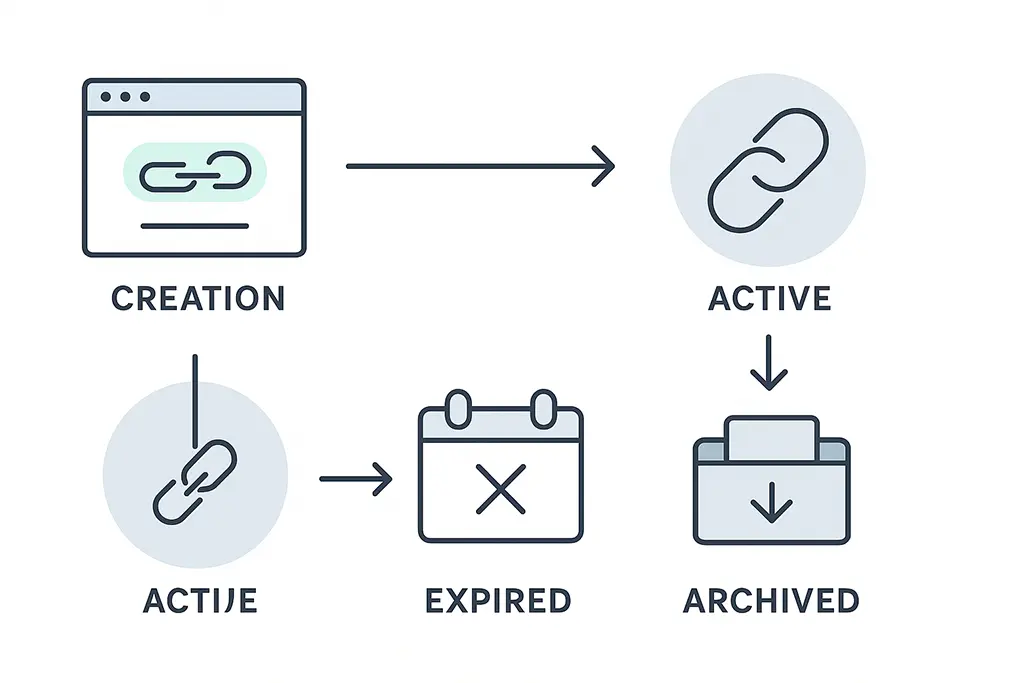
Short links feel operationally simple until you've been paged at 2am because a campaign link that "should have expired" is still routing 50k daily visitors to a discontinued product page. That's not a hypothetical — it's the kind of incident that makes teams finally start treating link lifecycle as infrastructure, not housekeeping.
Every short link you publish is a live redirect rule sitting in your datastore. It has no expiry date unless you set one. It survives email archives, PDF exports, QR codes printed on physical media, and browser bookmarks you'll never see. The gap between "campaign ended" and "link traffic dropped to zero" is often measured in years, not weeks. Managing that gap deliberately is what separates a short URL platform from a long-term liability generator.
This article covers how to build a link lifecycle system that handles expiration, transformation, and retirement without breaking user trust or your analytics. The examples use our stack: Spring Boot 3.x, MariaDB 11, and Redis — but the patterns apply broadly.
Why "Set and Forget" Destroys Trust Over Time
The simplest mental model: short links tied to time-bound campaigns need an explicit expiration plan at creation. Evergreen links need a scheduled review cadence. Everything else is gambling with your domain reputation.
The core problem is that short links obscure intent by design. A long URL like /blog/2022/summer-sale-ended signals its own obsolescence. A short link like vvd.im/s22 carries no such signal — it just silently delivers whatever the current redirect rule says. When that rule goes stale, users get a surprise. That surprise is often interpreted as your platform being untrustworthy, not just outdated.
Search engines compound this. Googlebot doesn't feel frustration, but it does track redirect consistency, HTTP response stability, and destination relevance. A domain where 20% of short links return 404s or redirect to unrelated homepages accumulates soft quality signals that are hard to diagnose and slow to recover from. We've seen this play out in crawl coverage reports — not dramatic drops, just a slow erosion of crawled-to-indexed ratios on short domains used carelessly.
Understanding the Lifecycle of a Short Link
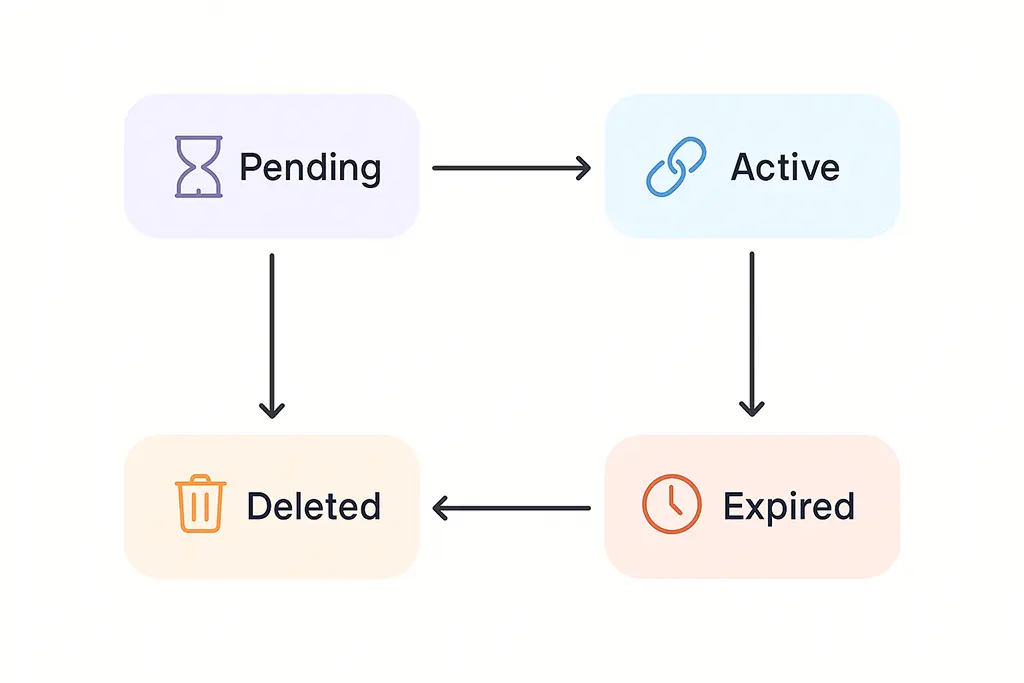
Every short link moves through distinct phases whether you plan for them or not. The difference between robust systems and brittle ones is whether the state transitions are intentional and encoded in your data model.
Creation: Bake Lifecycle Intent Into the Data Model
The creation phase is where most teams skip the decisions that matter most. What's the intended lifespan? Is this a campaign link or an alias? Should it be reusable after expiry? These aren't UX questions — they're schema questions.
We store lifecycle metadata alongside every link. At minimum: a link_type
(campaign, evergreen, partner, internal), an optional expires_at timestamp,
and a post_expiry_action enum (archive, transform, hard_stop). Links created
without an expiry still have a review_after date computed from the type —
campaign links default to 90 days, evergreen to 365.
-- MariaDB: links table with lifecycle columns
CREATE TABLE short_links (
    id              BIGINT UNSIGNED  NOT NULL AUTO_INCREMENT,
    slug            VARCHAR(64)      NOT NULL,
    destination     VARCHAR(2048)    NOT NULL,
    link_type       ENUM('campaign','evergreen','partner','internal') NOT NULL DEFAULT 'campaign',
    expires_at      DATETIME         NULL,
    post_expiry_action ENUM('archive','transform','hard_stop') NOT NULL DEFAULT 'archive',
    transform_destination VARCHAR(2048) NULL,
    review_after    DATETIME         NOT NULL,
    created_at      DATETIME         NOT NULL DEFAULT CURRENT_TIMESTAMP,
    PRIMARY KEY (id),
    UNIQUE KEY uk_slug (slug),
    KEY idx_expires_at (expires_at),
    KEY idx_review_after (review_after)
) ENGINE=InnoDB DEFAULT CHARSET=utf8mb4;
Active Phase: Where Long-Term Risk Accumulates
Active links get the most attention because their metrics are visible. But this is also where links escape your control. Once a link appears in a downloaded PDF, a printed QR code, a third-party newsletter, or a Slack message archived in a client's workspace, you can redirect but you can't retract. The wider a link spreads during active use, the more carefully you need to handle its eventual expiry.
We track a max_daily_clicks per link, recorded during active phase.
When post-expiry traffic exceeds 10% of that peak 90 days after expiry, it triggers
an alert — someone is still actively using the link from a source we didn't anticipate.
That's when transformation (not hard stop) becomes the right call.
Decay: Detecting It Before Users Do
Decay is the most dangerous phase because it's invisible by default. The link still resolves. Traffic just gradually drops. But the users who do arrive are increasingly landing somewhere that no longer matches their expectation.
We detect decay with a simple weekly job: for any link where the destination returns a non-2xx response, or where the destination's title tag has changed significantly since link creation, we flag it for review. A Levenshtein distance check on the page title is crude but effective for catching repurposed landing pages.
// Spring Boot: scheduled destination health check
@Scheduled(cron = "0 0 3 * * MON") // every Monday at 3am
public void checkDestinationHealth() {
    List<ShortLink> activeLinks = linkRepository.findActiveLinksForReview(
            LocalDateTime.now().minusDays(7));

    for (ShortLink link : activeLinks) {
        DestinationCheckResult result = destinationChecker.check(link.getDestination());

        if (!result.isReachable() || result.isTitleDrifted(link.getOriginalTitle(), 0.4)) {
            reviewQueue.enqueue(link.getId(), result.getReason());
            log.warn("Link {} flagged for review: {}", link.getSlug(), result.getReason());
        }
    }
}
Retirement or Transformation: The Decision That Defines Your Brand
Retirement and transformation are not technical decisions — they're product decisions with technical implementation. The wrong choice made efficiently is still the wrong choice.
Retire when the link's original promise no longer exists and there's no meaningfully related destination. Transform when you can redirect to something that honors the user's original intent, even if the specific content is gone. Redirecting a discontinued product link to your products catalog is a transformation. Redirecting it to your homepage is a cop-out that users notice and distrust.
Expiration Strategies That Preserve Trust
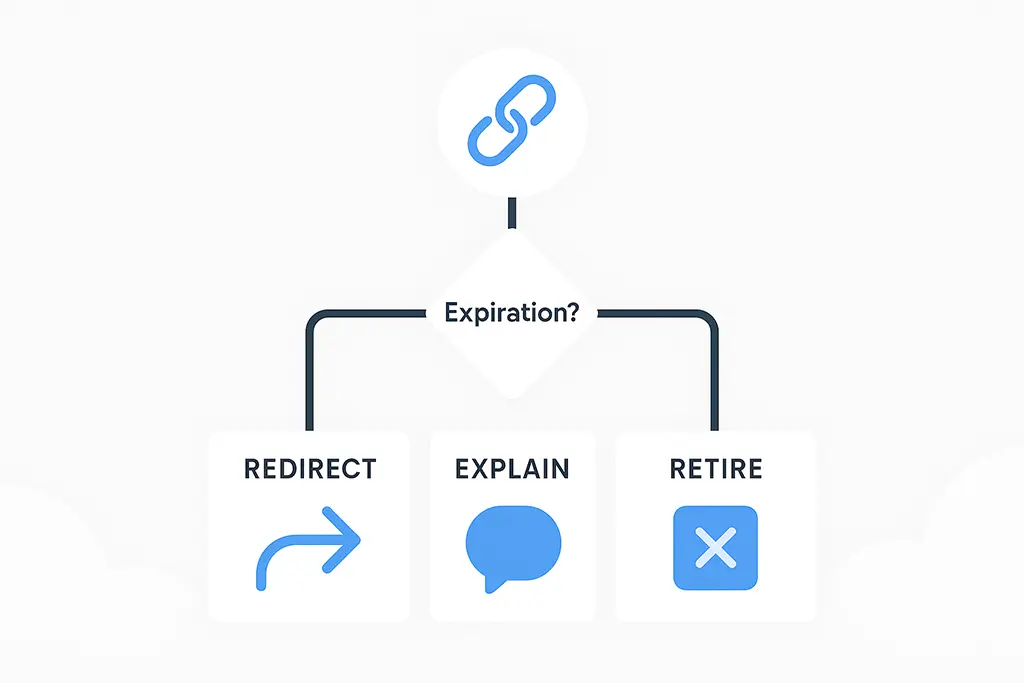
Soft Expiration: The 410 vs 302 Decision
Soft expiration routes expired links to a contextual landing page rather than returning an error or redirecting blindly to your homepage. The contextual page should acknowledge the original intent: "This campaign has ended. Here's where to find current offers."
The HTTP response code matters here. Most platforms default to 302 for redirects, which is correct for active links (preserves redirect flexibility). For soft expiration pointing to an archive page, 302 is also appropriate — you might update the archive destination later. For hard expiration, return 410 (Gone), not 404 (Not Found). 410 signals intentional removal; 404 signals a broken link. Search engines treat these differently, and users see the difference if you render a custom error page.
// Spring Boot: resolve with lifecycle-aware response
@GetMapping("/{slug}")
public ResponseEntity<Void> redirect(@PathVariable String slug, HttpServletRequest request) {
    ShortLink link = linkRepository.findBySlug(slug)
            .orElseThrow(() -> new ResponseStatusException(HttpStatus.NOT_FOUND));

    asyncClickRecorder.record(link, request); // non-blocking, always record

    if (link.isExpired()) {
        return switch (link.getPostExpiryAction()) {
            case HARD_STOP -> ResponseEntity.status(HttpStatus.GONE).build(); // 410
            case ARCHIVE   -> ResponseEntity.status(HttpStatus.FOUND)
                    .location(URI.create(buildArchiveUrl(link))).build();    // 302
            case TRANSFORM -> ResponseEntity.status(HttpStatus.FOUND)
                    .location(URI.create(link.getTransformDestination())).build();
        };
    }

    return ResponseEntity.status(HttpStatus.FOUND)
            .location(URI.create(link.getDestination()))
            .build();
}
Hard Expiration: When and How to Use It
Hard expiration is appropriate for security-sensitive links (password resets, invite tokens), legally constrained content, or links that were issued in error. The rule is: if there's any scenario where the link being active creates harm, hard stop is mandatory.
What most implementations get wrong is the user experience at the dead end. A 410 with no context is nearly as bad as a broken link. We render a custom 410 page that includes the slug, a timestamp of when it expired, and if public policy allows, the reason. Users are surprisingly understanding when given an honest explanation. They're not understanding when they get a blank error or an irrelevant redirect.
Evergreen Links: Silent Drift Is the Real Risk
Evergreen links look low-maintenance but accumulate the most technical debt. Because they never expire, they never get reviewed. Over time, teams repurpose them for adjacent use cases, update the destination silently, and gradually break the implicit promise made to users who bookmarked the link three years ago.
The fix is enforced review cycles. Our review_after column on evergreen links
defaults to 365 days and cannot be null. When a link passes its review date without being
explicitly renewed, it moves to a "review required" state that doesn't break the redirect
but flags it in the admin dashboard and sends a notification to the link owner. No link
stays evergreen by inertia — it has to be intentionally re-confirmed.
Lifecycle Mistakes That Compound Over Time
The most common lifecycle failure — redirecting expired links to the homepage — is so widespread it's almost a default behavior. It's easy to implement and feels harmless. In practice, it trains users that your short links are unpredictable. Once that association forms, even valid links get extra scrutiny. We've seen campaigns underperform measurably after a high-visibility link redirect failure on the same domain.
Slug recycling is worse. Reusing a slug for a completely different campaign assumes that all copies of the old link are gone. They never are. A recipient who bookmarked the link from your Q1 promotion will hit your Q3 campaign destination with zero context. If they report it as suspicious (which happens), you've created a trust incident that affects every link on your domain.
-- MariaDB: prevent slug recycling with grace period check
-- Block slug reuse if it was used in the past 365 days
SELECT COUNT(*) FROM short_links
WHERE slug = :slug
  AND (
      expires_at IS NULL
      OR expires_at > DATE_SUB(NOW(), INTERVAL 365 DAY)
  );
The subtler mistake is letting tracking overhead accumulate without pruning. Each redirect hop you add — for attribution, A/B testing, or analytics passthrough — adds latency and failure surface. We audit our redirect chains quarterly. Any link with more than two hops (short domain → tracking layer → destination) gets refactored. Users clicking a link that takes 800ms to resolve in 2025 notice. And they don't come back.
Building Lifecycle Management Into Your Platform
The key insight is that lifecycle management has to be structural, not procedural. If it depends on someone remembering to review links after a campaign ends, it will fail at scale. Encode the lifecycle into your data model at creation time, automate the transitions, and build review tooling that surfaces work rather than requiring people to go looking for it.
For teams running on vvd.im, this means: define link_type
and post_expiry_action on every link at creation. Set expires_at
for anything tied to a campaign. Schedule your destination health checks to run weekly.
And treat slug recycling as a banned operation, not a convenience feature. A short link
that fails a user six months from now is a cost you're paying today, invisibly.