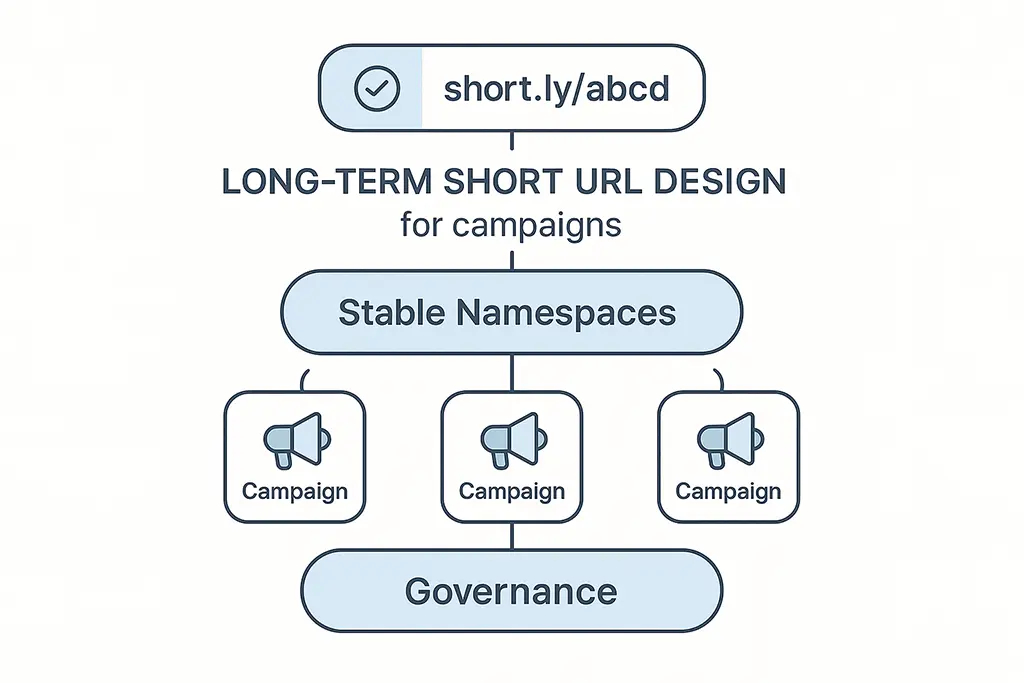
Most short URL advice is written for campaigns that last a week. You pick a slug, attach UTMs, send the email, and move on. The link either converts or it doesn't, and either way you're done with it in days. Long-term campaigns are a different discipline entirely. A link that needs to work reliably for 12 to 24 months — across platform changes, team turnover, site migrations, and creative refreshes — requires decisions at creation time that most people don't think about until something breaks.
I've been managing the redirect infrastructure for vvd.im for long enough to have inherited my own past mistakes. Links created early in the service's life with casual naming conventions became reporting problems six months later. A redirect chain that "saved some time" during a campaign setup added measurable latency that persisted for a year before anyone investigated it. These are not exotic failure modes — they're the predictable result of treating short URLs as disposable rather than as durable infrastructure assets.
This article is about designing short URLs that hold up over time. Not just technically, but operationally — in a world where the person who created the link may not be around when it needs to be updated.
Why Long-Term Changes the Rules
The failure modes for a weekend promo link and a 12-month evergreen campaign link are completely different. A weekend link just needs to work. A long-term link needs to survive: site migrations, CMS changes, team handoffs, UTM taxonomy revisions, and the slow entropy of "we'll fix that later" decisions that accumulate over months.
Small decisions compound. A naming shortcut that seemed harmless in January becomes a reporting ambiguity in July when a new analyst is trying to reconcile campaign data. A "temporary" 302 redirect that was supposed to last two weeks gets forgotten and stays in place for a year — which matters because 302s don't pass PageRank and may be treated differently by some analytics platforms than permanent redirects. A redirect chain with two hops instead of one adds latency that's imperceptible at launch but shows up in p99 metrics after the campaign has been running at scale.
The goal is straightforward: design short URLs as durable identifiers, not as one-time routing shortcuts. The redirect destination can change. The short URL itself should not.
The Four Non-Negotiables of Long-Term Short URLs
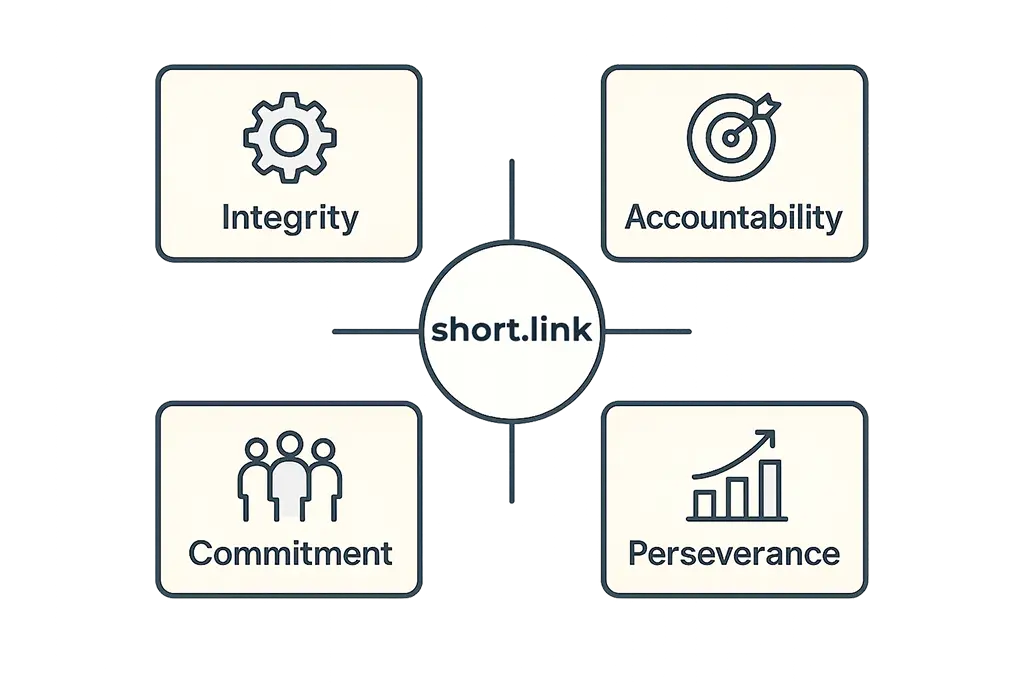
Every long-running campaign link needs to satisfy four properties simultaneously. Optimizing for one while neglecting the others is how you end up with links that are fast but unmeasurable, or stable but untrusted, or well-named but owned by nobody.
1) Stability: The Slug Is the Stable Surface, Not the Destination
Once a short URL has been distributed — in an email, on printed collateral, embedded in a partner's site, or indexed by a search engine — it is no longer fully under your control. You cannot recall it. You can only control where it points.
This is the core architectural insight for long-term links: the slug is a stable public API, and the destination is an internal implementation detail. The landing page can be redesigned, migrated to a new CMS, moved to a subdomain, or replaced entirely — and none of that needs to affect the short URL. The redirect layer is where that decoupling happens.
In practice, this means resisting the temptation to encode destination-specific information in the slug.
A slug like /spring-sale-landing-v2 is already coupled to a specific destination and a specific moment in time.
A slug like /seasonal-offer can point to whatever the current offer is, updated server-side without
touching the public URL.
2) Trust: Consistency Is What Builds It
For campaigns that run long enough to generate repeated exposure, trust isn't a one-time assessment — it accumulates through consistent behavior. A user who clicks a link from your branded short domain six times over three months and always arrives somewhere relevant and safe has built a pattern-recognition shortcut: this domain is reliable.
That accumulated trust is fragile in specific ways. Using a different short domain for a subset of campaigns breaks the pattern. A redirect that suddenly goes somewhere unexpected — even for a legitimate reason, like a site migration — can register as suspicious to users who remember the previous destination. And a link that starts returning errors because a campaign was "retired" without a graceful redirect damages trust retroactively.
For long-term campaigns, trust design means: one branded domain used consistently, redirect destinations that remain topically coherent with the link's history, and explicit lifecycle management so links don't die silently.
3) Measurement: Attribution Must Survive the Real World
A long-term link will be clicked across environments that were not all anticipated at launch: in-app browsers that strip referrers, email security scanners that pre-fetch URLs before users see them, social media platforms that wrap links in their own redirect layers, and messaging apps that cache previews. Each of these can corrupt or lose attribution data.
The measurement architecture for a long-term link needs to be defensive by design. Server-side click recording is more robust than client-side analytics for this reason — it captures the event at the redirect layer, before any client-side stripping can occur. UTM parameters need to be carried forward through the redirect (appended to the destination URL) rather than relying on the referring URL, which may be lost.
On vvd.im, click events are recorded at the server level the moment the redirect response is issued, with the full request context captured before any client-side processing happens. Here's the core recording logic:
@GetMapping("/{slug}")
public ResponseEntity<Void> redirect(
        @PathVariable String slug,
        HttpServletRequest request) {

    Optional<ShortLink> link = linkService.resolveFromCache(slug);
    if (link.isEmpty()) {
        return ResponseEntity.notFound().build();
    }

    // Record click before redirect — don't lose the event to client-side failure
    clickRecorder.recordAsync(ClickEvent.builder()
        .slug(slug)
        .ip(extractClientIp(request))
        .userAgent(request.getHeader("User-Agent"))
        .referer(request.getHeader("Referer"))
        .timestamp(Instant.now())
        .build());

    String destination = appendUtmIfAbsent(
        link.get().getTargetUrl(),
        link.get().getUtmDefaults()
    );

    return ResponseEntity
        .status(HttpStatus.MOVED_PERMANENTLY)
        .header(HttpHeaders.LOCATION, destination)
        .header("Cache-Control", "no-store")
        .build();
}

private String appendUtmIfAbsent(String url, Map<String, String> utmDefaults) {
    UriComponentsBuilder builder = UriComponentsBuilder.fromUriString(url);
    MultiValueMap<String, String> existing = builder.build().getQueryParams();
    utmDefaults.forEach((key, value) -> {
        if (!existing.containsKey(key)) {
            builder.queryParam(key, value);
        }
    });
    return builder.toUriString();
}
The appendUtmIfAbsent logic is worth noting: it only appends UTM defaults if the parameter isn't already
present. This means you can override per-campaign UTMs at the destination URL level without losing the server-side defaults
for traffic that arrives without parameters — which is common for links shared without context, like those copied into
messaging apps.
4) Governance: Ownership Is Non-Negotiable
A long-term link without a documented owner is a future incident. Not a potential one — an eventual one. At some point, the destination page will change, the campaign will evolve, or something will break. Without a clear owner, the link either stays broken or gets fixed by whoever notices — neither of which is a process.
Governance for short links doesn't need to be bureaucratic. It needs to answer three questions at link creation time: who can update this link's destination, what should happen to this link when the campaign ends, and where is the documentation that explains what this link is for. A database field for owner, expiry policy, and campaign notes costs almost nothing to implement and saves significant confusion over 12-month timescales.
Naming Strategy: Design for the Year-Two Problem
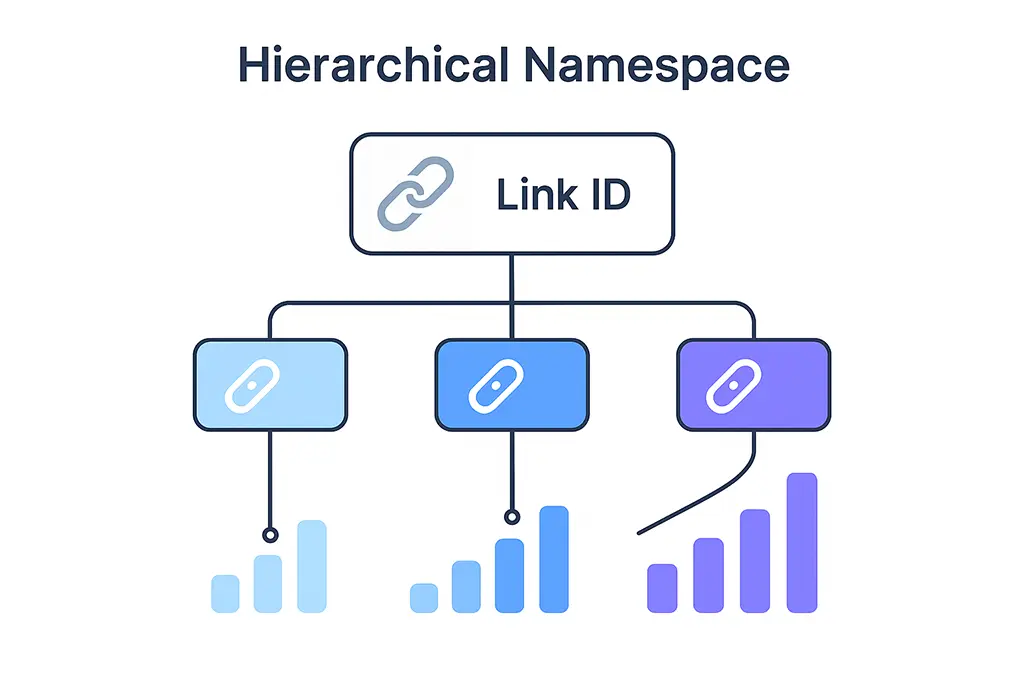
The naming problem for long-term links is not about being clever — it's about being unambiguous at a distance. A slug that made perfect sense to the person who created it often becomes opaque six months later when someone else is trying to audit campaign performance or debug an attribution gap.
Random strings solve the collision problem but create a readability problem. The goal is a naming convention that's both human-readable and machine-filterable — something you can search for, sort by, and understand in a report without needing to look up what it refers to.
A Practical Naming Pattern
A four-segment pattern works well for most long-running campaign contexts:
/{product}-{intent}-{channel}-{year}

# Examples:
/onboarding-activation-email-2026
/checkout-recovery-sms-2026
/referral-acquisition-social-2026
The year segment might feel redundant, but it's what makes Year Two manageable. When you're running the same
type of campaign in 2027, you create /onboarding-activation-email-2027 rather than updating the
2026 link's destination. This preserves the historical attribution data for the 2026 campaign while giving the
2027 campaign a clean tracking baseline.
What to avoid: version suffixes in public paths (-v2, -final), date specificity
beyond the year (-april-15), and any segment that encodes the destination rather than the intent.
Destination-specific naming creates coupling between the slug and the page, which breaks the stability property
every time the page changes.
Keep Versions Internal, Not Public
If you're iterating on landing pages for a long-term campaign — which you should be — track the destination versions in your link management system, not in the slug. The public URL stays constant. Internally, you maintain a changelog of destination updates with timestamps and the reason for each change. This gives you an audit trail without creating slug proliferation.
Redirect Architecture for Links That Last
Redirect design for long-term links is primarily about minimizing the number of moving parts that can drift or fail over a 12-24 month period. Every hop in a redirect chain is a dependency. Every dependency is a potential point of failure or latency regression.
One Hop, Always
The target architecture is a single redirect: short URL to final destination. If your analytics platform, affiliate tracking system, or marketing automation tool wants to add its own redirect layer, push back hard on that — or consolidate it server-side so the user-visible hop count stays at one.
On the vvd.im infrastructure (Nginx 1.28 → Spring Boot → MariaDB + Redis), a warm-cache redirect completes in under 5ms end-to-end. Adding a second hop to a third-party analytics endpoint can easily add 80-150ms depending on that endpoint's geographic proximity and load. Over a 12-month campaign running at volume, that latency compounds into measurable engagement drop-off on mobile — where users are more sensitive to redirect delays than on desktop.
301 vs 302: Make the Decision Deliberately
For long-term links, 301 (permanent) is almost always the right choice — but with one important caveat.
Once a browser or CDN caches a 301, changing the destination requires waiting for that cache to expire,
and you have limited control over when that happens. If you anticipate needing to update destinations
frequently (for seasonal campaigns or A/B testing), use 302 (temporary) or 307 and include
Cache-Control: no-store in the redirect response to prevent caching.
# Nginx: force no-cache on redirect responses from the application
location / {
    proxy_pass http://127.0.0.1:8080;
    proxy_set_header Host $host;
    proxy_set_header X-Forwarded-For $proxy_add_x_forwarded_for;

    # Strip any upstream Cache-Control and enforce no-store at the edge
    proxy_hide_header Cache-Control;
    add_header Cache-Control "no-store" always;

    proxy_buffering off;
    proxy_read_timeout 3s;
}
This configuration gives the application full control over redirect behavior without browser or CDN caching
interfering. For links where the destination is truly permanent and will never change, you can remove the
Cache-Control override and let the 301 be cached — which improves repeat-visitor performance
significantly.
Preserve UTMs Through the Redirect
Platform-level UTM stripping is a real problem for long-term links. Some email clients, messaging apps, and social platforms rewrite or truncate URLs, dropping query parameters in the process. The defensive approach is to store UTM defaults at the link level and append them server-side during redirect resolution — as shown in the click recording code above. This way, even if a sharing platform strips the parameters, the server restores them from the canonical campaign configuration.
Lifecycle Planning: Retiring Links Without Breaking Them
"Long-term" doesn't mean permanent. Campaigns end. Offers expire. Products get discontinued. The question is what happens to the link when the campaign it supported no longer exists.
A link that returns 404 is a broken promise to everyone who bookmarked it, shared it, or embedded it somewhere you can't control. The right approach is a graceful retirement strategy, defined at link creation time:
- Links for time-limited offers should redirect to a successor page or a generic "this offer has ended" page after expiry — not to a 404 or a blank screen
- Links for evergreen content can simply have their destination updated to the most current version of that content
- Links that are genuinely obsolete (product discontinued, company pivot) should redirect to the closest relevant resource, with a documented reason for the retirement in the link management system
The expiry policy should be a field in your link schema, not a post-hoc decision. When you create a long-term link, you should answer: what should this link do after the campaign ends? Setting that policy at creation time costs nothing and saves a significant amount of reactive cleanup work later.
Governance Checklist Before Creating a Long-Term Link
- Does the slug follow the established naming convention and remain meaningful without context?
- Is there a named owner who is responsible for destination updates and retirement?
- Is the redirect a single hop from short URL to final destination?
- Are UTM defaults stored at the link level to survive platform-level parameter stripping?
- Is the redirect type (301/302) appropriate for the expected update frequency?
- Is there a documented expiry policy — what should this link do when the campaign ends?
- Is the link registered in a system of record that survives personnel changes?
Short URLs as Infrastructure, Not Artifacts
The mental model shift that makes long-term link management tractable is treating short URLs as infrastructure rather than as campaign artifacts. Campaign artifacts are disposable — you create them, use them, and discard them. Infrastructure is maintained, documented, and owned. It has a lifecycle policy. It degrades gracefully when components underneath it change.
That framing changes how decisions get made at creation time. You don't rush the naming convention because "it's just a link." You don't skip the expiry policy because "we can figure that out later." You don't add a second redirect hop because it's convenient today — because you know that convenience has a compounding cost when the link is still running in 18 months.
A short URL that was designed for longevity looks boring from the outside. It has a predictable slug, it redirects in one hop, it passes UTMs cleanly, and it resolves to something sensible even years after the original campaign ended. That boringness is the point. The links that feel cleverly constructed at launch are usually the ones that become problems later. Design for year two, not for launch day.