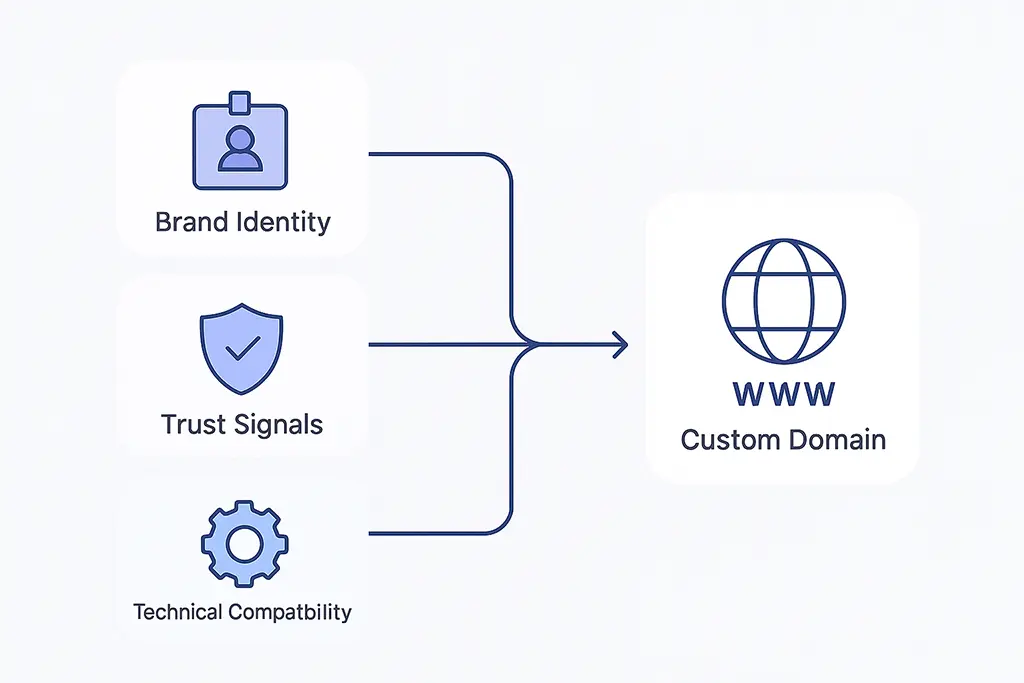
Running a URL shortener with a generic shared domain is a liability. You're sharing reputation with thousands of other users, and one bad actor on the same domain can get your links flagged or blocked in email clients and firewalls. We've run vvd.im long enough to know: switching to a custom domain isn't just branding polish — it's an operational decision that affects deliverability, analytics fidelity, and campaign longevity. Here's what actually matters when choosing and setting one up.
Why Custom Domains Matter Beyond Aesthetics
Shared Domain Risk Is Real
When you use a generic shortener, your links ride on the same domain as every other user on that platform. If another user sends spam or phishing links, your links get flagged too. Email services like Gmail and Outlook evaluate sender reputation at the domain level — not per-account. We've seen campaigns drop deliverability by 15–20% purely from shared domain blocklist contamination, with zero changes on our end. A dedicated domain isolates your reputation.
Analytics Integrity Depends on Domain Stability
Attribution breaks when you change domains mid-campaign. UTM parameters survive redirects fine, but referrer chains get truncated across domain hops in some privacy-focused browsers. If you're comparing click data across months and you switched shorteners in between, your time-series data is meaningless. Owning your domain means you own continuity.
Redirect Control Enables Live Campaign Updates
When a campaign ends, you don't need to invalidate the link. You update the destination. We maintain a small Redis-backed route table that maps slugs to destinations — changing a destination is an O(1) write that propagates in under 100ms with no downtime. That means go.yourbrand.com/holiday can silently redirect to a post-holiday landing page without editing a single email or social post.
// Spring Boot: update redirect destination via API
@PatchMapping("/links/{slug}/destination")
public ResponseEntity<Void> updateDestination(
        @PathVariable String slug,
        @RequestBody @Valid DestinationUpdateRequest req) {
    linkService.updateDestination(slug, req.getUrl());
    redisTemplate.opsForValue().set("redirect:" + slug, req.getUrl(), 30, TimeUnit.DAYS);
    return ResponseEntity.noContent().build();
}
How to Choose the Perfect Custom Domain
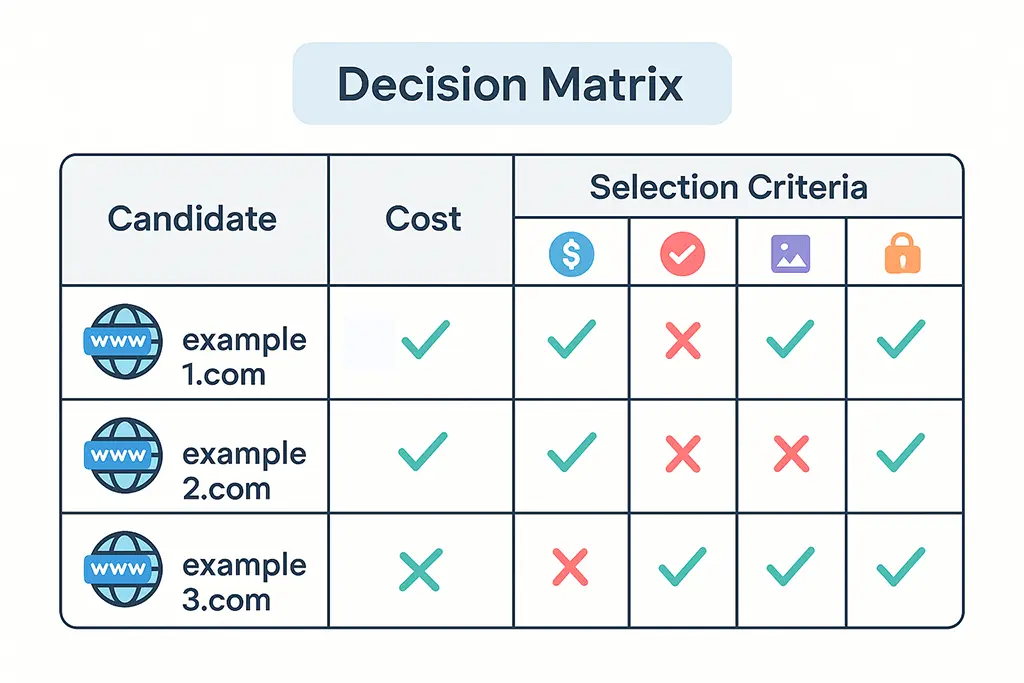
Subdomain vs. Alternate TLD vs. Domain Hack — What We Actually Use
The three options each come with tradeoffs that become obvious only after deployment. A subdomain like go.yourbrand.com is the safest choice: it inherits your main domain's SSL certificate if you use a wildcard cert, requires no new registrar account, and keeps DMARC/SPF alignment intact for email deliverability. The downside is length — every subdomain character eats into your printed/QR link budget.
A different TLD like yourbrand.io or yourbrand.link gets you a shorter root while staying recognizable. The risk is registrar dependency and renewal pricing surprises — some new TLDs spike in price after the promotional period. We set renewal budget alerts for all short domains in our stack for exactly this reason.
Domain hacks like splitting a word across domain and TLD (e.g., spar.kl) are clever but fragile. Country-code TLDs have separate governance, sometimes with residency requirements or restricted transfer options. If the ccTLD registry has an outage or changes policy, you have no fallback. For production traffic, we avoid them for primary domains.
Length, Pronunciation, and the QR Code Test
The real constraint on domain length isn't visual — it's QR code density. A longer domain means a denser QR code, which is harder to scan at small print sizes or from a distance. We benchmark our short links at 40 total characters (domain + slug), which produces a QR version 3–4 code readable at 2.5cm printed size. If your domain alone exceeds 12–14 characters, you're sacrificing slug readability to compensate.
On the pronunciation side: say it aloud in three languages your audience speaks. "Vvd.im" fails this test in English but that was intentional for a developer-facing tool. A consumer campaign domain should be unambiguous to a phone support agent reading it to a customer.
Availability and Legal Due Diligence
Before committing, run the candidate name through the USPTO TESS database and equivalent registries for your operating countries. A domain being available at a registrar doesn't mean it's clear of trademark conflicts. We've seen companies register domains only to receive cease-and-desist letters six months later when campaign volume made them visible. Check both the exact string and phonetic equivalents in relevant classes (IC 035, 042 for marketing/SaaS use cases).
Best Practices for Implementing Custom Domains
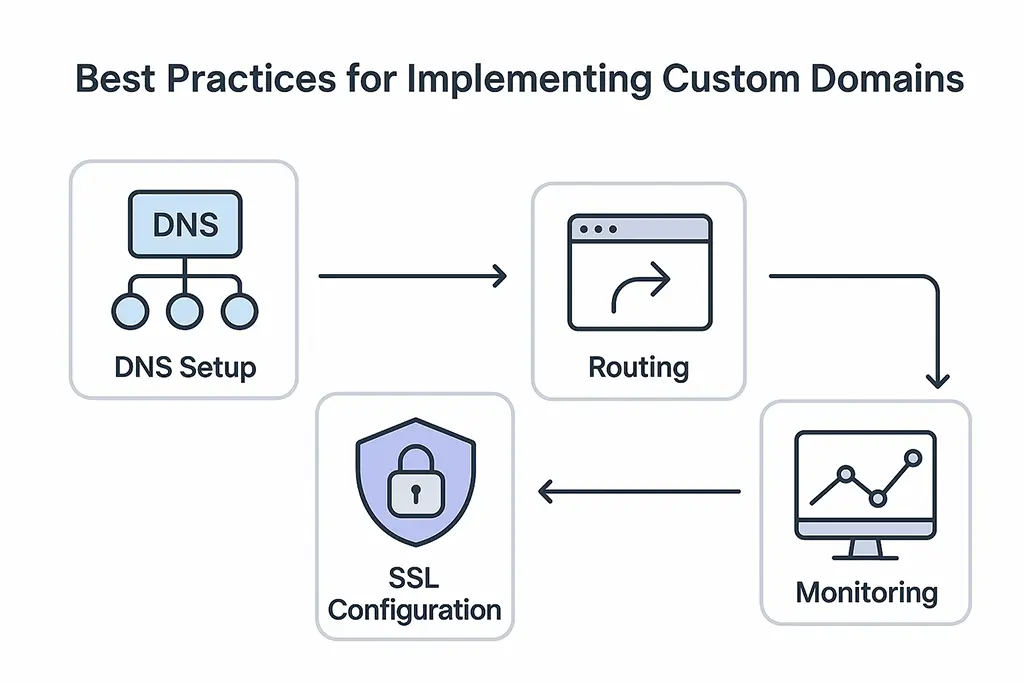
DNS and SSL — The Configuration That Actually Matters
Most guides say "add a CNAME and enable SSL." That's incomplete. For a redirect service running under load, you need to think about TTLs and failover. We use a 300-second TTL on our short domain's A records — long enough to reduce resolver load, short enough to cut over in under 5 minutes if we need to failover to a backup origin. For SSL, we use Let's Encrypt with Certbot in standalone mode on Nginx 1.28, with auto-renewal via systemd timer:
# /etc/nginx/sites-available/vvd.im
server {
    listen 80;
    server_name vvd.im;
    return 301 https://$host$request_uri;
}

server {
    listen 443 ssl http2;
    server_name vvd.im;

    ssl_certificate     /etc/letsencrypt/live/vvd.im/fullchain.pem;
    ssl_certificate_key /etc/letsencrypt/live/vvd.im/privkey.pem;
    ssl_protocols       TLSv1.2 TLSv1.3;

    location / {
        proxy_pass         http://127.0.0.1:8080;
        proxy_set_header   Host $host;
        proxy_set_header   X-Real-IP $remote_addr;
        proxy_set_header   X-Forwarded-For $proxy_add_x_forwarded_for;
        proxy_set_header   X-Forwarded-Proto $scheme;
    }
}
One thing worth noting: if you're running multiple custom domains for different clients or brands on the same Spring Boot instance, wildcard certs won't work across different root domains. You'll need individual certs per domain, or a cert management solution like cert-manager if you're running on Kubernetes.
Slug Naming Conventions That Scale
Random slugs are fine for one-off links, but for managed campaigns you need a convention. We enforce a pattern of /type-campaign-channel, for example /promo-summer24-email or /dl-whitepaper-linkedin. This structure makes GROUP BY queries in MariaDB trivially filterable by prefix without needing a separate campaign tag column:
-- MariaDB: aggregate clicks by campaign prefix
SELECT
    SUBSTRING_INDEX(slug, '-', 2)  AS campaign,
    COUNT(*)                        AS total_clicks,
    COUNT(DISTINCT visitor_hash)    AS unique_visitors
FROM click_events
WHERE created_at >= DATE_SUB(NOW(), INTERVAL 30 DAY)
GROUP BY campaign
ORDER BY total_clicks DESC;
This only works if everyone creating links follows the convention. We enforce it at the API layer — slugs matching a campaign pattern must exist in the campaign registry table, or the creation request is rejected. Ad-hoc slugs are allowed but flagged for review.
Tracking Across Channels Without Overcounting
When you run the same branded short link in email, social, and SMS simultaneously, click attribution gets messy. Prefetching is the main culprit: email clients like Outlook and iOS Mail scan links to generate previews, generating fake click events. We filter these by checking user agent strings and recording the request country against the sending country — a prefetch from a US email client to a Korean recipient is suspicious. We also ignore clicks under 300ms after link creation, which catches most bot prefetches.
A/B Testing Backhalves
We've run enough slug A/B tests to have a strong prior: descriptive slugs outperform promotional ones in email, and short slugs outperform descriptive ones in SMS where the link is visible in the preview. /save20 gets higher SMS clicks, /summer-discount-guide gets higher email clicks on the same destination. The mechanism is user expectation — SMS users scan fast, email readers verify before clicking. Test on your own audience, but this pattern holds consistently in our data.
Mistakes That Cost You Later
Using Multiple Domains for the Same Brand
It's tempting to spin up a new short domain per product line or campaign. Don't. Every domain you add is a renewal to track, a cert to manage, a DNS zone to maintain, and a blocklist reputation to build from scratch. We consolidated from four short domains to one and cut our domain-related ops time by 70%. Use slugs to differentiate, not domains.
Skipping 301 vs 302 Distinction
Short links should use 302 (temporary) redirects, not 301 (permanent). A 301 gets cached aggressively by browsers — if you update the destination behind a slug, some users will keep hitting the old destination for weeks due to browser cache. 302 gives you the update control you're paying for with a custom domain. The SEO cost is minimal for redirect-only domains since you're not trying to rank the short URL.
// Spring Boot: always use 302 for short link redirects
@GetMapping("/{slug}")
public ResponseEntity<Void> redirect(@PathVariable String slug, HttpServletRequest request) {
    String destination = linkService.resolve(slug)
            .orElseThrow(() -> new ResponseStatusException(HttpStatus.NOT_FOUND));

    asyncClickRecorder.record(slug, request); // non-blocking

    return ResponseEntity.status(HttpStatus.FOUND) // 302
            .location(URI.create(destination))
            .build();
}
No Lifecycle Policy on Old Links
Links you created two years ago for a discontinued product still consume slugs and generate click events that pollute your analytics. Set an expiry policy: archive or 410 (Gone) links that haven't been clicked in 12 months for non-evergreen campaigns. We run a nightly MariaDB job that flags stale links for review rather than auto-deleting — someone always has a link embedded somewhere unexpected.
Conclusion
Choosing a custom short domain is about more than brand presentation. It determines how much operational control you retain over your links, how clean your analytics are, and whether your infrastructure can evolve without breaking existing campaigns. If you're running links through vvd.im, treat the domain with the same discipline you'd apply to your primary domain: monitor its reputation, manage its lifecycle, and build naming conventions that make your data useful six months from now. A short domain done right is invisible infrastructure — it just works, and you never have to apologize for a broken link.